
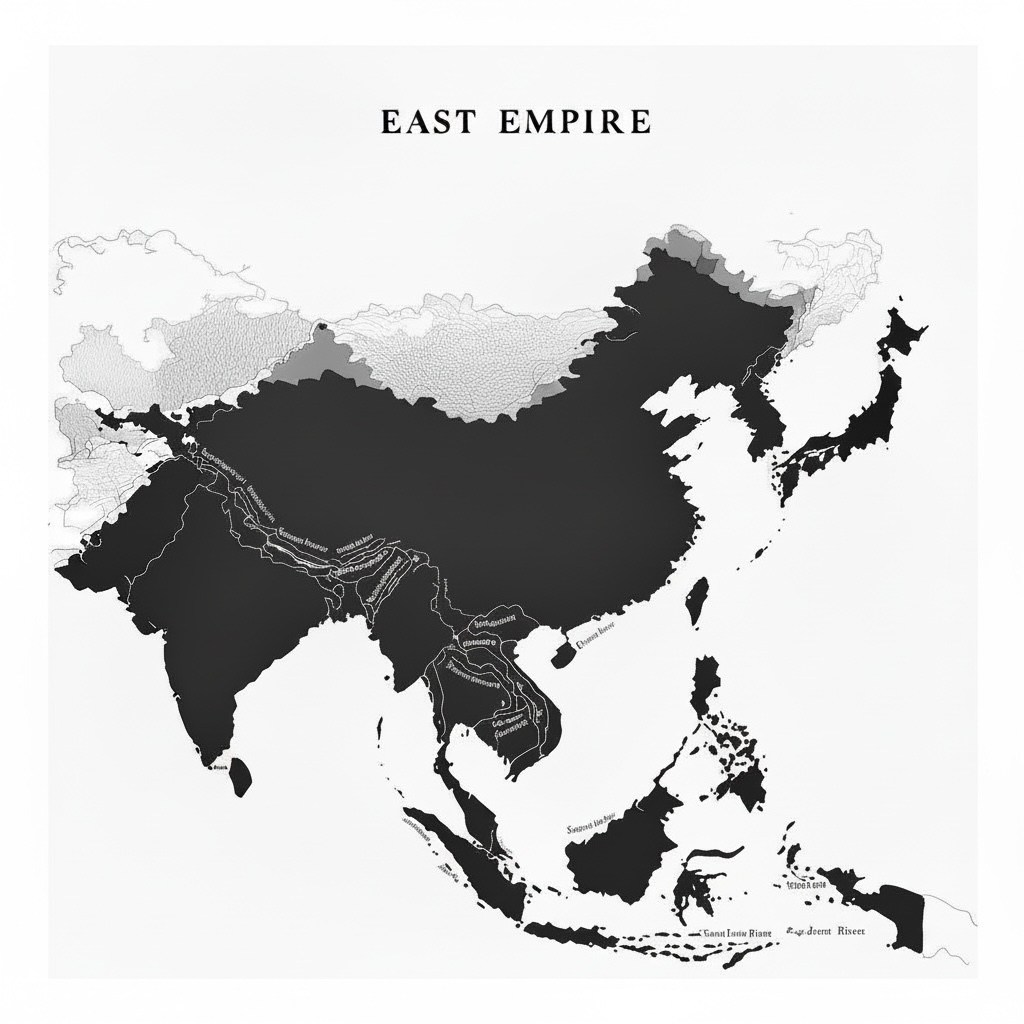
The East Empire
Overview
The East Empire is the territorial sphere within which the Ministry of the East exercises its authority. It is not a state, nor a public government, but a defined operational domain where the Ministry enforces its mandate of harmony across all systems.
Territory and Boundaries
The East Empire encompasses China, Japan, North Korea, South Korea, the Philippines, Indonesia, Thailand, Vietnam, Malaysia, Singapore, Myanmar, Cambodia, Laos, India, Nepal, Sri Lanka, and Bhutan.
Its boundaries are determined by where the Ministry is able to sustain order. Regions that fall outside these conditions, including parts of Russia and Mongolia, are not included within the Empire’s scope.
Within its territory, the Empire overlays existing nations without altering their visible governance.
Founding
The East Empire was defined at the moment the Ministry of the East was instituted by a coalition of deities to prevent systemic collapse across human and non-human domains.
The founders established the territory and assigned its governance to the Ministry, creating a structure capable of operating without public recognition.

Mandate
The East Empire exists under a single mandate: the preservation of harmony.
Harmony is defined as equilibrium across human, spiritual, and environmental systems. Conflict may occur within acceptable limits. Sustained imbalance is not permitted.
Governance
The Ministry of the East governs all activity within the Empire. It operates through institutions embedded across the territory, most notably its academies, where individuals are identified, trained, and monitored.
Its authority applies across all species. No entity within the Empire exists outside Ministry jurisdiction.
Operational Position
The East Empire does not expand beyond the Ministry’s capacity to enforce its mandate. Where stability can be maintained, the Ministry remains. Where it cannot, the Ministry does not extend.
To the public world, the East Empire does not exist.