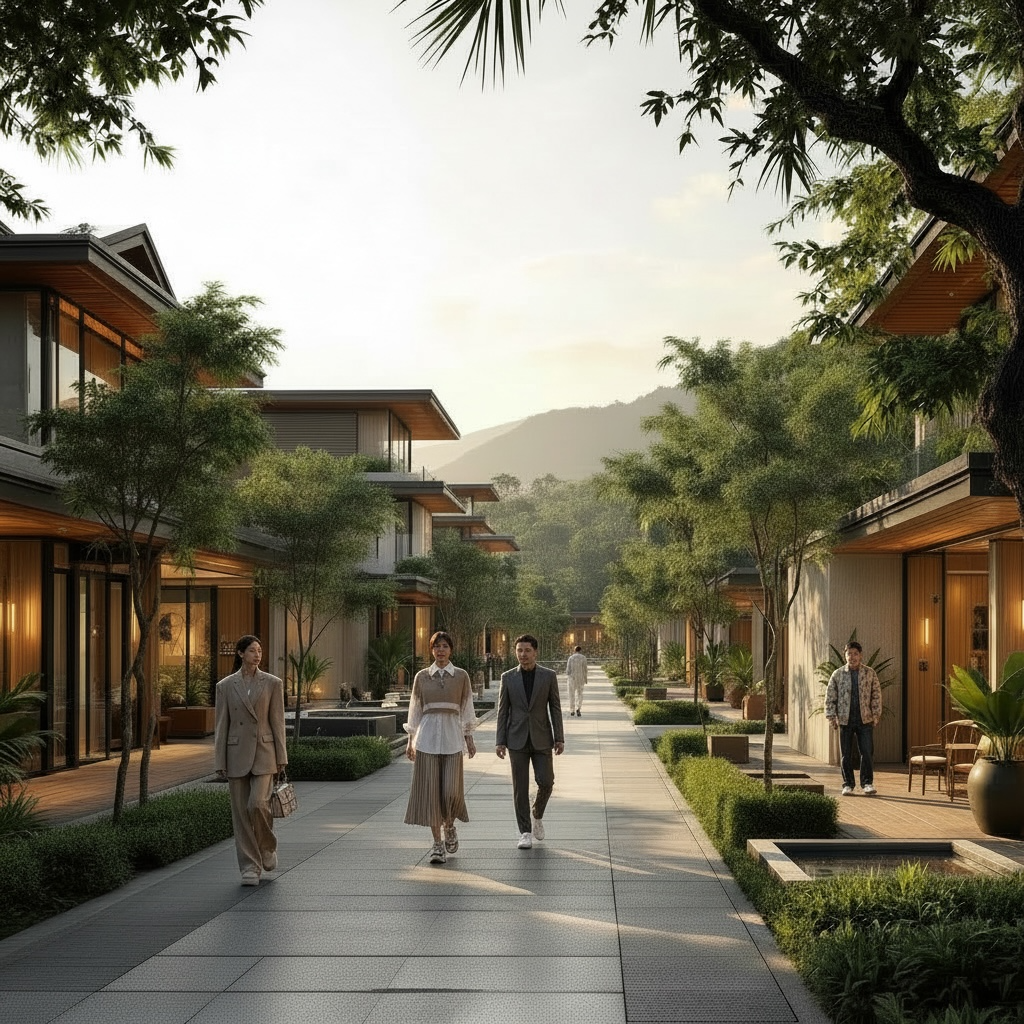
Mayaw — Auxiliary Civil Zone
OVERVIEW
Mayaw is a Ministry-regulated auxiliary civil zone located within the operational territory of Mandalangan Peak Prep. It functions as a controlled environment designed to accommodate non-operational populations, including families, visitors, and individuals not currently under direct institutional evaluation.
The town is presented externally as a modern tropical spa district in the Philippines, offering retail, hospitality, and wellness services within a stable and aesthetically consistent environment.
Within the Ministry’s system, Mayaw is not classified as an independent settlement, but as a contained civilian interface.
STRUCTURAL FUNCTION
Mayaw exists to absorb external presence without disrupting core operations. It provides a controlled space where families can remain in proximity to students while being separated from the internal mechanisms of Mandalangan Peak Prep.
The town maintains a stable, low-variance environment, with minimal disruption, controlled population flow, and continuous passive observation.

MOVEMENT REGULATION
Access between Mandalangan Peak Prep and Mayaw is facilitated through the Anagolay Agian, a protected route that enforces boundary conditions between controlled and uncontrolled zones.
Within the path, hostile entities are unable to enter. Individuals or beings with confirmed intent to harm are automatically displaced beyond its limits.
Beyond the path, the Ministry does not enforce protection. External conditions are considered active and unmanaged.
RISK MANAGEMENT
Mayaw is classified as a low-risk zone only within its boundaries. The surrounding areas remain populated by entities that are not aligned with Ministry control, including predatory and deceptive species capable of targeting unprotected individuals.
Incidents occurring outside designated zones are recorded but not prevented.
SYSTEM ROLE
Mayaw supports the Ministry’s broader structure by maintaining separation between operational environments and civilian-facing spaces. It enables continuity of family presence, controlled exposure to normalcy, and stabilization of individuals within the system.
It is not designed for freedom, but for balance.