Amomongo — The Ape-Like Creature of Negros Occidental
Overview
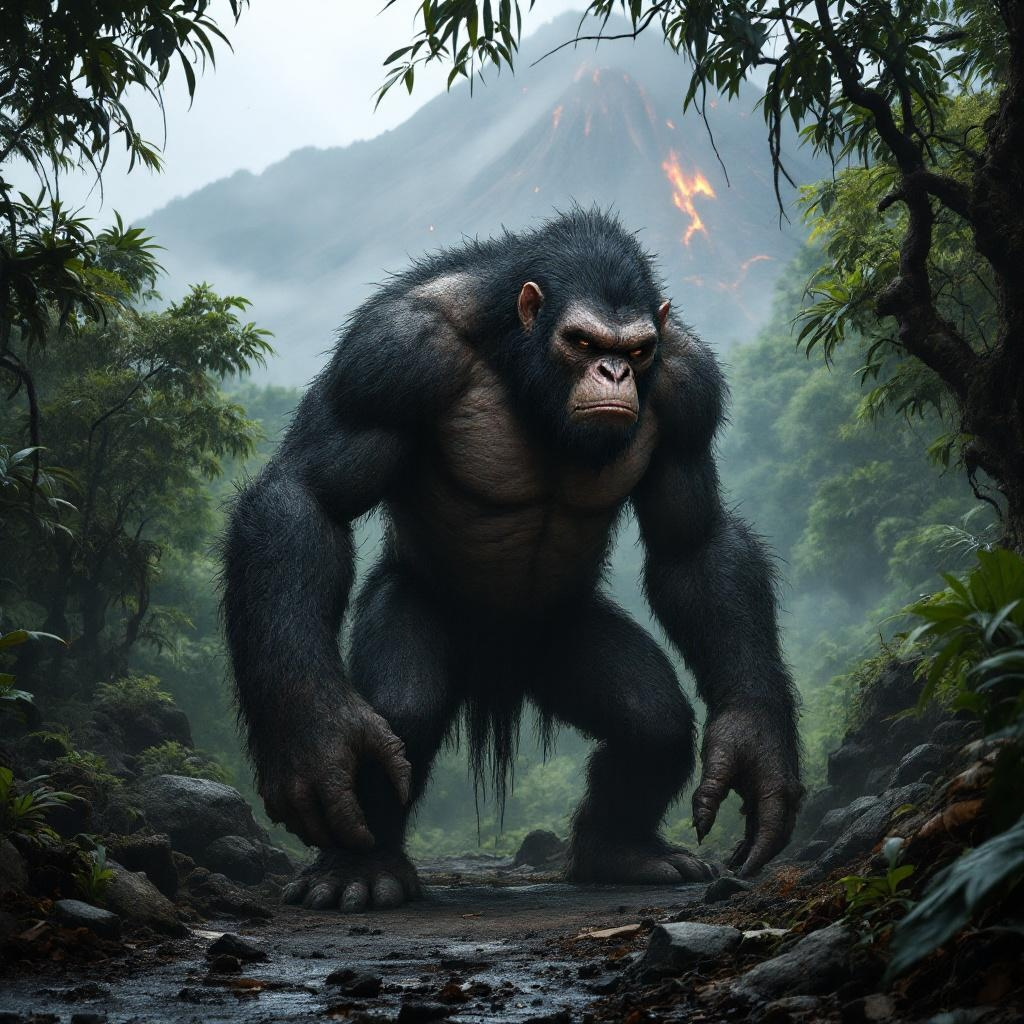
The Amomongo is a creature in Philippine folklore described as a large, ape-like being native to Negros Occidental. It is commonly depicted as tailless, with a powerful build and sharp claws, and is associated with mountainous and forested areas, particularly near volcanic regions.
Accounts of the Amomongo often place it near the foothills of Mount Kanlaon, where it is said to move between caves and dense vegetation.
Etymology and Regional Context
The name “Amomongo” is derived from the Hiligaynon language, where it is commonly understood to mean “old monkey.”
The creature is primarily associated with Negros Occidental, making it one of the more region-specific entities within Philippine folklore. Its presence in oral traditions reflects the island’s landscape, where forests, mountains, and volcanic terrain form a natural setting for such accounts.
Physical Description
The Amomongo is described as a large, monkey-like creature with no tail, a muscular frame, and elongated limbs suited for climbing and movement across uneven terrain.
It is often characterized by:
- a hunched posture
- thick body hair
- sharp claws used for gripping and tearing
- a face that appears partially human but distinctly animal
Some accounts describe variations in appearance, including a rare instance of a white Amomongo seen near a cave at the base of Mount Kanlaon.
Behavior and Accounts
Folklore describes the Amomongo as territorial and capable of interacting with human settlements. In older accounts, it is said to raid villages, attack individuals, and, in some cases, take children.
These accounts emphasize its strength and unpredictability rather than organized intent. The creature is not described as strategic, but as reactive and driven by instinct.
Encounters are typically brief and occur at the edge of human habitation, reinforcing its association with boundaries between settled and wild environments.
In more recent records, similar sightings have been noted within forested zones surrounding Mandalangan Peak Prep. These observations are consistent with the creature’s established pattern of remaining within dense, high-coverage environments while approaching areas of structured activity without sustained contact. 
Cultural Interpretation
The Amomongo reflects a class of folklore that connects human communities with the surrounding natural landscape. Its presence in stories may represent both a warning and an explanation for dangers found in forested and mountainous areas.
As with many regional creatures, its description varies depending on the account, suggesting that it exists more as a pattern of sightings and narratives rather than a single fixed form.
Position within the Dragon Vase Archive
Within the Dragon Vase Archive, the Amomongo is classified as a terrestrial creature associated with high-density natural environments.
Its recorded behavior aligns with boundary-based activity, often appearing near areas where human and non-human territories intersect. Unlike structured entities within the system, the Amomongo is not defined by institutional integration, but by observed presence and recurring patterns across accounts.
Conclusion
The Amomongo remains one of the more localized creatures in Philippine folklore, tied closely to the terrain and traditions of Negros Occidental.
Its continued presence in storytelling reflects an enduring connection between environment, memory, and the unknown.